Orynbasar Bakytuly Zhakayev:
It is true that every year, May 31, the Day of Remembrance of Victims of Political Repression, is celebrated with great joy and sadness in my heart. Because this is my history, my life. I have crossed the thresholds of my past life, and I have returned to my path.
When I am seventy years old, will the difficulties I have experienced and the past be forgotten when I have spread my roots like a giant tree in my independent Kazakhstan and my descendants have grown?
I am a lone hoof, a descendant of my ancestors who continue the path of my great-souled ancestor. My surname is Zhakayev, my name is Orynbasar. My father's name is Bakyt. Bakyt's father is Zhakayev, and it is my duty to tell the story of Tokhtamysh - the story of a person who became a victim of the brutal politics of those terrible years - to my future generation.
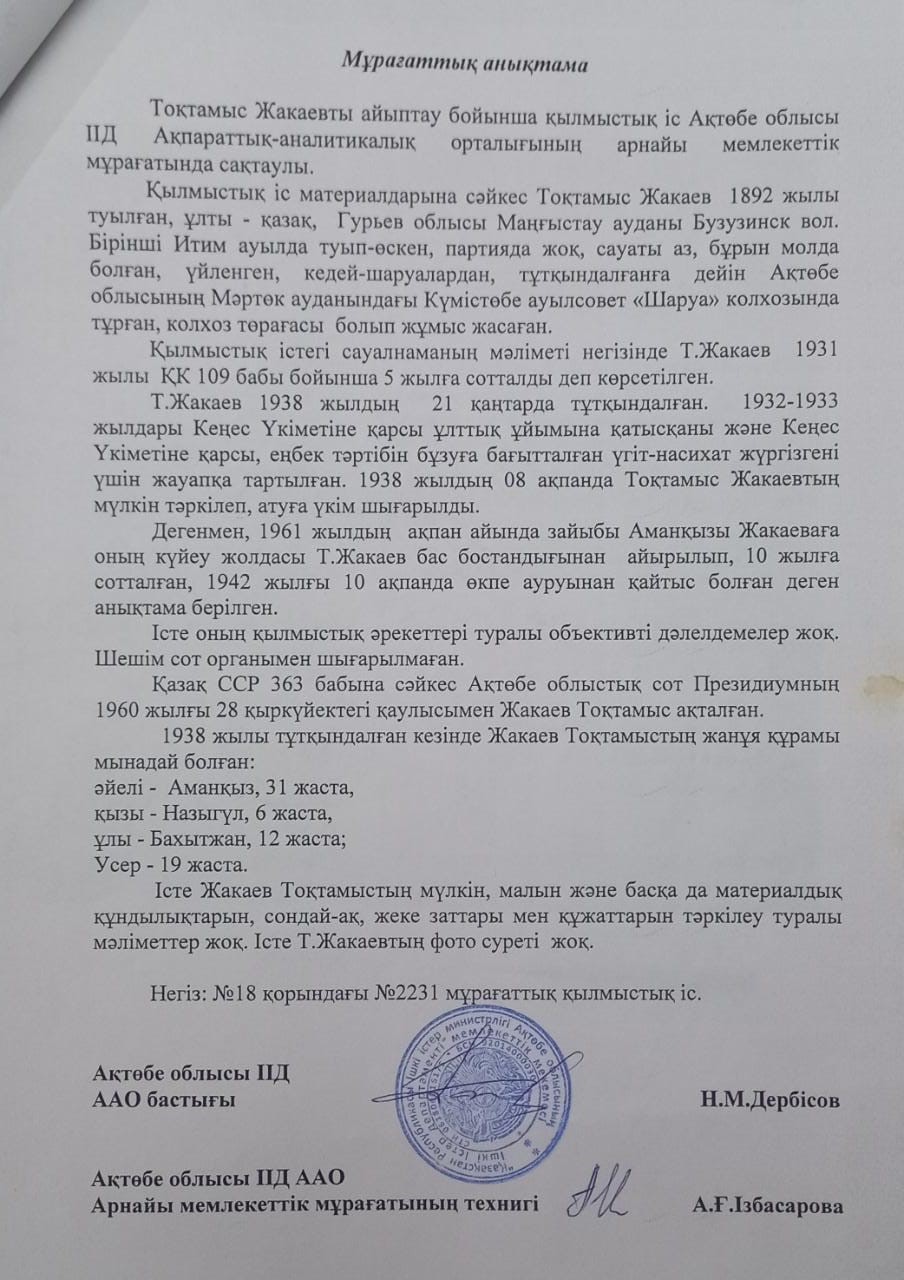
My grandfather Tokhtamysh was born in 1892 in the village of Itim, the first village of Buzuzinsk, Mangystau district, Guryev region, and was a mullah. At a time when the Stalinist policy was prevailing everywhere, the Adais were afraid of their brave and stubborn character and, fearing that they would not unite and become a strong force, the jandaisaps, who were afraid of them, began to disperse them from all sides. Thus, 60 families of Adais from Atyrau were resettled in the Martok district of the Aktobe region. Arriving in Martok, the Kumistobe village council established the "Sharua" collective farm, and my grandfather was the chairman of that collective farm.
I know from my grandmother's memories that on February 21, 1938, my grandfather was taken away from the place where he was holding a meeting as the chairman of the collective farm on charges of "being involved in a national organization against the Soviet government and having opposing views." One of the two people taken from the "peasant" was my grandfather Toktamysh, and the other was my grandfather's nephew, the chairman of the village council, Nazargeldin Aman. The accused were held in Martok for three days, and then sent to Aktobe.
According to the memoirs of my grandmother Amankyz, the confiscated items were a cow, a horse, a saddle, a stuffed animal, and leather. Among these items was an eight-winged yurt. Although my grandmother was given a certificate of the confiscated items, she was left in a state of despair. Having lost her husband at the age of 31 on false charges, her 6-year-old daughter Nazgul and 12-year-old son, my biological father Bakhyt, and the family of the "enemy of the people", my grandmother Amankyz remains helpless.
My grandfather was sentenced to be shot in 1938. However, the blood-stained, hair-pulling horsemen misled my grandmother Amankyz by giving her a false certificate that her husband had been sentenced to 10 years in prison and had died of lung disease on February 10, 1942.
On September 28, 1960, by the verdict of the Aktobe Regional Court, the charges against my grandfather were completely dropped due to the lack of evidence. Thus, justice was established in the scales of history. However, the lack of work to honor the names of these victims of repression, who remained in the shadows of the history of Independent Kazakhstan, and to convey to future generations that they were only victims of a cruel policy, certainly saddens me.
Information provided by: Orynbasar Bakytuly Zhakayev. Aktobe city, 2023.
The material was prepared for publication by: Kuralai Kuandykovna Sarsembina, Sh. Candidate of Historical Sciences, Astana branch of the Ualikhanov Institute of History and Ethnology.