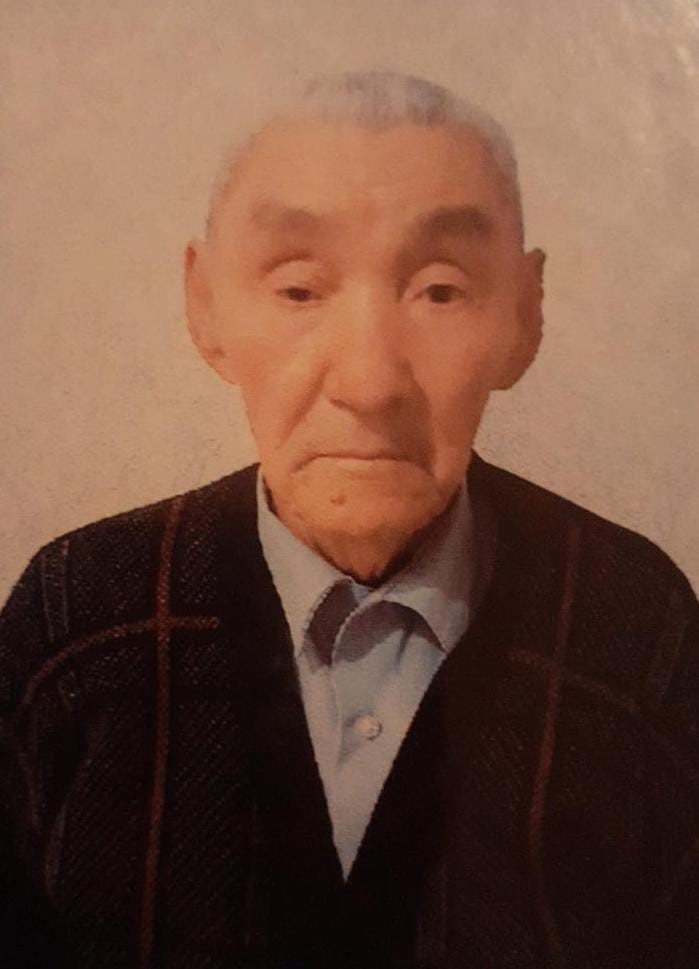
I am Zhakanuly Bisen, born on May 30, 1933. Today I live in the village of Karazhar, Baiganin district, Aktobe region.
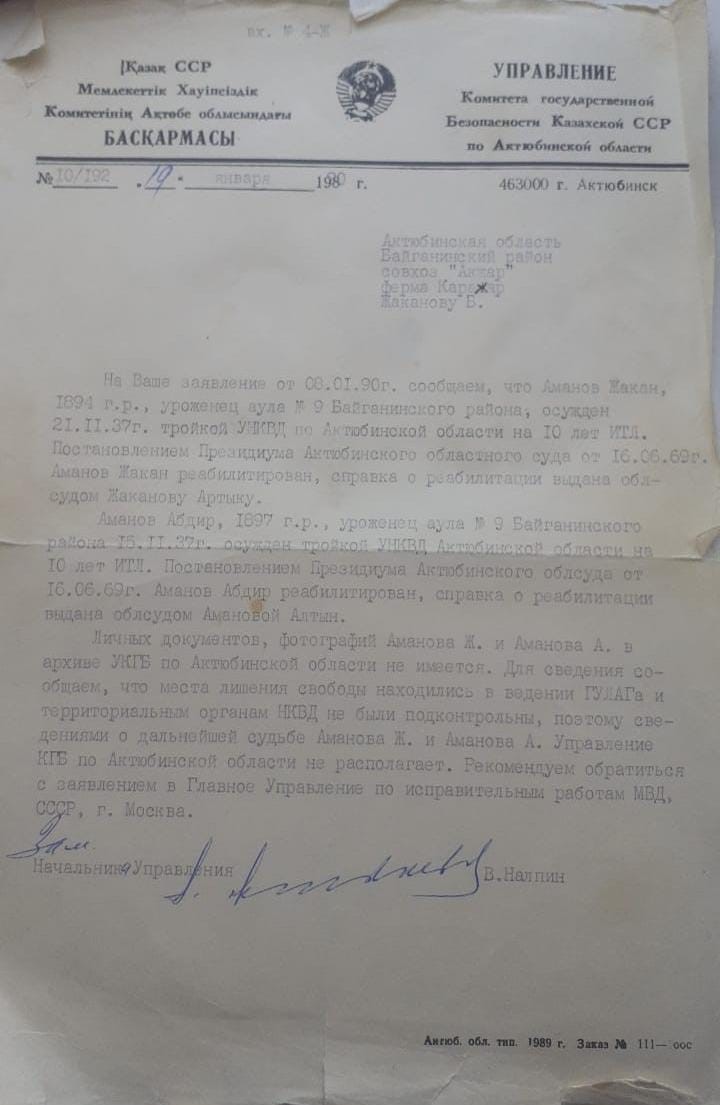
My father is Zhakan Amanov, born in 1894, my mother is Khalipa Amanova, born in 1894. My father was arrested on charges of being a rich man. When my father was arrested, I was 4 years old, and my brother was 7 years old. My father's father, Aman, died in 1927, and my grandmother died on March 10, 1946 at the age of 86. Her name was Baktyly. She was alive when she took her children. All I remember is my father stroking my forehead.
My father had 4 brothers. The eldest, Kobylash, died early. Then my father Zhakan, Abdir, Asan (born in 1900). My grandfather Asan died at a young age. Asan had one son, Karagul, born in 1931. He died in 1981. He has descendants.
Abdir had a daughter. Her name is Tazhen. She also has descendants. So, from my grandfather Aman, only Zhakan and Abdir remained. Both of them were persecuted and destroyed by local horsemen, calling them "the sons of a rich man."
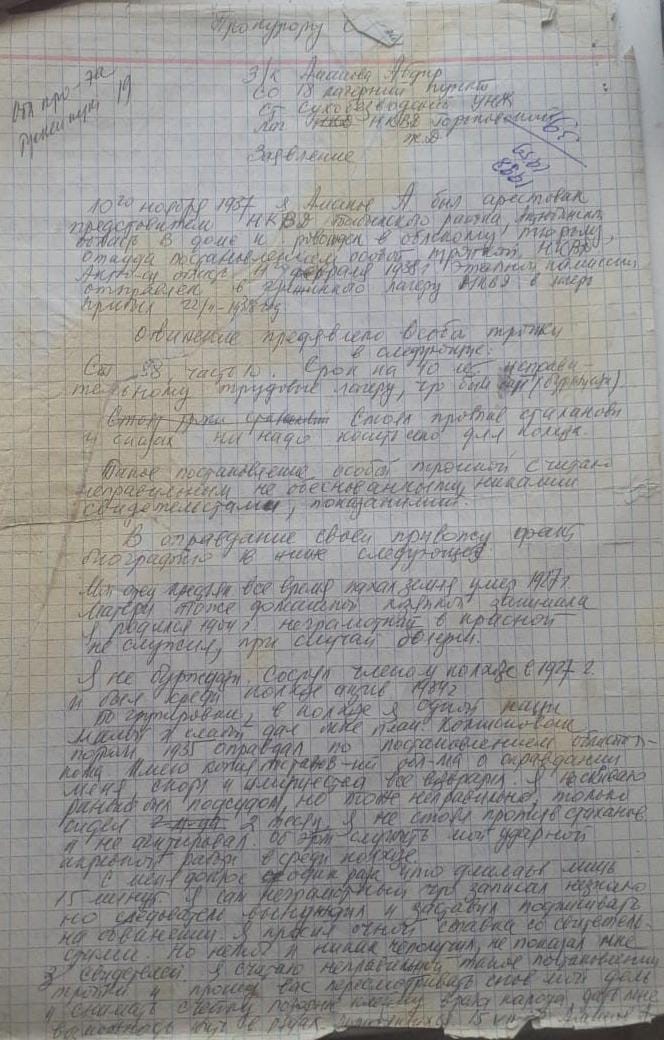
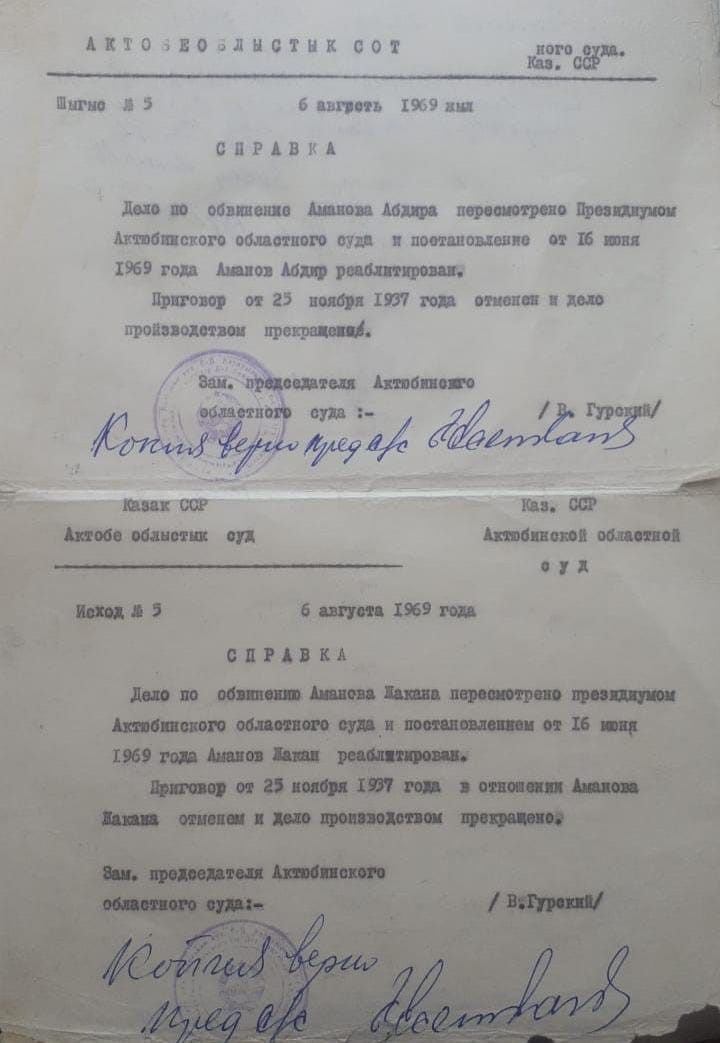
My father's younger brother, Amanov Abdir, born in 1897, was also innocently arrested. Various false testimonies were recorded in the investigation. They were accused of being "connected with Trotsky" and "wealthy," and both were sentenced to 10 years. In 1943, both of them died in the Krasnoyarsk Territory. We have two children from our father. My brother's name is Artyk Zhakanuly. He was born in December 1930 in the village of Karazhar (then Tabyn, now Baiganin district). My older brother Artyk died on May 12, 2012 in the city of Aktobe.
When I grew up and regained consciousness, I asked my grandmother, "In November 1937, your father, my husband Amanov Zhakand, born in 1894, and my father-in-law Amanov Abdir, born in 1897, were taken away. We don't know why they were arrested. Knowing that would be a disaster. So, we, eight people, were left in two families, helpless and helpless."
I don't know that my grandmother was persecuted, but when I was little, I remember eating with my grandmother on an iron plate and an iron spoon...
The "reputation" of "child of the enemy of the people" became an obstacle to our lives. It was the fall of 1940. While we were playing asik with the village children, a tall, dark-haired man with a camel-hair hat and a curly mustache turned to us and said, "Why are you playing asik with the children of the enemy of the people? Don't let them go, they will bring trouble on you." The words "child of an enemy of the people" froze our backs like frost. My brother and I were exhausted, unable to say a word or answer, and we came home groaning. Our mother's words, "Don't cry, my children, one day he will be born, you will still be a citizen, there is a saying, "a person who is not a victim of a crime." The ones you carry, your uncles and brothers will also turn white," seemed to strengthen our weakened courage and strength.
We never thought that he would burn us for our father. One day, when I came home from school, everyone in the house was crying. They surrounded my uncle Abdir's daughter, Tazhen. My mother was in the 6th grade. Because she was the daughter of an enemy of the people, she was not allowed to join the Komsomol. Then, I still remember our father's mother, Baktyli, encouraging us by saying, "Oh, my children, don't cry, don't cry, the dirt on white cloth won't come off, we need to be patient."
When I was in the 7th grade, my class teacher took a list of students who were going to join the Komsomol. I was there too. I was soon removed from the list and not allowed to join the Komsomol...
After graduation, I wanted to enter a law school. But they didn't let me because I was a "rich man's son." Then I wanted to be a soldier and enter a school that trains soldiers. But they didn't let me go there either...
But I didn't lag behind my peers and successfully graduated from the Aktobe Pedagogical College and the Kazakh Language and Literature Department of the A.S. Pushkin Pedagogical Institute in Uralsk.
Our mother would come and talk about our father and his younger brother. "Our only wish now is that you be healthy. As soon as we took your father and brother away, we were forbidden to communicate with our brother himself. We followed Salkynbay, Oraz, and Torekhan, who had been harassing us, and said, "We have a lot of work to do." "The first time we were isolated from the collective farm," he would say quietly, glancing at the door as if someone were listening. Although he tried not to show the great sorrow and grief inside, it was evident from his sighs and face. In March 1969, I said to my aunt (Abdir's wife), whom I had raised as my mother, "We don't know why our people were arrested, whether they are dead or alive. Why don't we write a letter to the appropriate authorities and ask? What kind of advice would you give?" My aunt was deep in thought. Even though it had been 32 years since she had lost her husband, my aunt, who had spent many sleepless days and nights, and who had not let her husband's house fall down, raised her head and said, "I almost forgot, Abdir wrote his last letter in the month of cuckoo in 1943. "He said that he was walking with his father-in-law (he was referring to my father, Zhakan) without leaving him. So how could I know what would happen without knowing?" he said. Then he said, "If you write, write not as yourself, but as me, so that I can personally share the tears of those who were innocently imprisoned. What other strength do I have left?"
On April 18, 1969, at the Council of Ministers of the Kazakh SSR